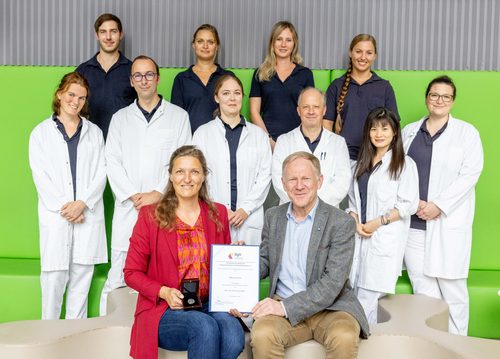
Great hopes are being placed worldwide in research with extracellular vesicles, which is considered one of the most important cell therapies of the future. The Good Manufacturing Practice Laboratory, abbreviated as GMP Laboratory Salzburg, is among the few academic-pharmaceutical institutions worldwide that can produce vesicles for administration to humans.
International institutions such as the biotech company Paracrine Therapeutics from Singapore collaborate with this centerpiece of the Center for Cross-Sectional and Tissue Regeneration. Salzburg plays an outstanding role in terms of equipment, expertise, and quality.
Vesicles – more than just “garbage”
Extracellular vesicles, long dismissed as the “garbage system” of cells, have an important communication function in the body: they transmit targeted information between cells, organs, and even between different organisms. Vesicles have potential as gatekeeper systems. Their role is particularly promising in regenerative medicine.
“It’s like two soap bubbles merging with each other,” explains Rohde. “The information thus reaches the target cell.” Research groups from Essen, Hannover, and Salzburg, in addition to the GMP laboratory, play an important role. New therapeutics based on vesicles are being developed in a cleanroom environment.
A significant advantage of these tiny powerhouses is their volume, which is at a ratio of 1:3,000,000 compared to the cell. They have the ability to suppress inflammatory processes and reduce scar formation. This tremendous potential could be an important key, for example, in the healing of hearing implants in the inner ear.
You might also be interested in
11. September 2026
Hospital@Home: How Hospital-Level Care Can Be Delivered at Home
Providing patients with hospital-level care at home: Hospital@Home can help relieve pressure on hospitals while enabling patients to receive care in familiar surroundings. What opportunities does the model offer – and what is needed to implement it in Austria? Experts discussed these questions at Technology Talks Austria 2026.
28. May 2026
Joint Research Leads to Patent Application
An important milestone for Salzburg as a research and innovation hub: Salzburg University of Applied Sciences and ABB’s Machine Automation Division (B&R) have jointly filed a patent application in the field of AI-based energy efficiency.
21. May 2026
The Future of Microchip Manufacturing Comes to Salzburg
With the opening of a new competence center for so-called panel-level packaging, Lam Research is sending a strong signal for Salzburg as a technology and research hub.
15. April 2026
From AI to energy: Four Salzburg companies recognised
In 2026, the Salzburg Innovation Award was presented for the first time, introducing a new distinction for particularly innovative companies in the region. The four awarded projects highlight the diversity of innovation in Salzburg – ranging from satellite data and artificial intelligence to recycling technologies and digital energy infrastructure.