With the funding program doc.funds.connect, five joint doctoral programs can start at universities and universities of applied sciences. The total funding volume for the first call is five million euros, and selection and evaluation were carried out by the Austrian Science Fund (FWF) in collaboration with the Christian Doppler Society. Due to the positive response, the Austrian Federal Ministry of Education, Science and Research is providing an additional seven million euros for a second call.
The following locations were able to establish joint doctoral programs through an international evaluation process:
- Salzburg University of Applied Sciences, University of Salzburg
- Upper Austria University of Applied Sciences, University of Linz
- University of Applied Sciences Technikum Wien, Vienna University of Technology
- University of Applied Sciences Wiener Neustadt, Medical University of Vienna, University of Veterinary Medicine Vienna
- University of Applied Sciences Joanneum, Graz University of Technology
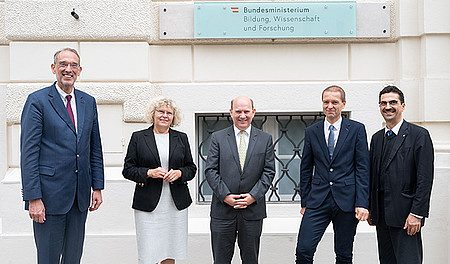
“Cooperative doctorates strengthen research cooperation between universities and universities of applied sciences and promote young researchers. Therefore, I am pleased that a total of 28 high-quality project cooperations were submitted. Due to this great response, we will launch a second call with a budget increase to seven million euros by the end of this year,” explains Minister of Science Heinz Faßmann on the occasion of the first round of approvals.
The Salzburg doctoral program “doc.hci – Designing Meaningful Human-Technology Relations”
- Involved partners: University of Salzburg, Salzburg University of Applied Sciences
- Coordination: Alexander Meschtscherjakov (University of Salzburg)
- Funding volume: 1,005,148.04 euros | Project duration: 4 years
The new doctoral program deals with the understanding and design of the relationship between humans and digital technology. Due to the ubiquity of these technologies and their increasing agency, for example, artificial intelligence, humanity is becoming increasingly intertwined with them. This requires a paradigm shift in the field of information and communication technology, which requires significant innovations in theoretical foundations and methodological approaches.
The creation of these foundations is the overarching scientific goal of the doc.hci program. Doctoral candidates deal with the design of meaningful human-machine relationships in five challenging contexts (mobility, health, education, work, play) by taking a radically new perspective on the nature of these relationships. Doc.hci builds on the joint master’s program HCI of the University of Salzburg and Salzburg University of Applied Sciences.
Information on all doctoral programs can be found here.
This might also interest you
3. June 2026
Featuring the Future: Young Talents Showcase Their Ideas
What does the future look like? Perhaps exactly as it was presented at the MINT Challenge 2026. In line with our motto “Featuring the Future”, 317 students from nine MINT secondary schools across Salzburg developed their own research projects over the past few weeks. At the grand finale on June 2 at the BAUAkademie Salzburg, the best teams presented their ideas to an audience and an expert jury.
28. May 2026
Joint Research Leads to Patent Application
An important milestone for Salzburg as a research and innovation hub: Salzburg University of Applied Sciences and ABB’s Machine Automation Division (B&R) have jointly filed a patent application in the field of AI-based energy efficiency.
21. May 2026
The Future of Microchip Manufacturing Comes to Salzburg
With the opening of a new competence center for so-called panel-level packaging, Lam Research is sending a strong signal for Salzburg as a technology and research hub.
15. April 2026
From AI to energy: Four Salzburg companies recognised
In 2026, the Salzburg Innovation Award was presented for the first time, introducing a new distinction for particularly innovative companies in the region. The four awarded projects highlight the diversity of innovation in Salzburg – ranging from satellite data and artificial intelligence to recycling technologies and digital energy infrastructure.