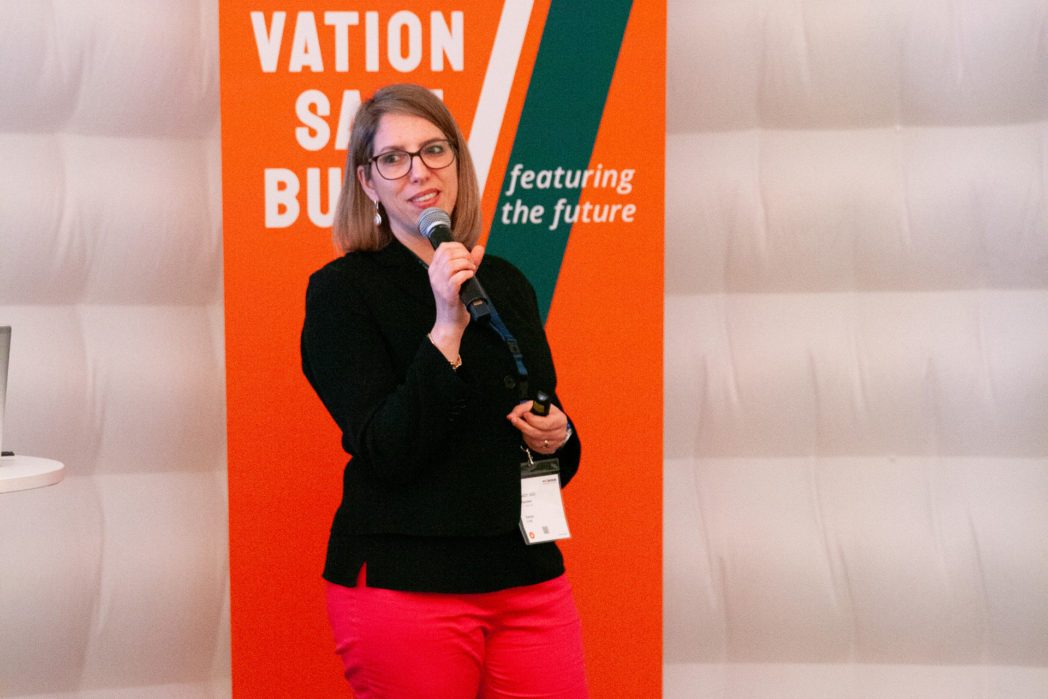
Diesel fuel cannot be replaced by just one technology in transport. Esther Lind, General Manager Sales and Innovation at the Salzburger Aluminium Group (SAG), made people sit up and take notice at the Industry Talks of Innovation Salzburg at salz21.
For a long time, diesel was THE solution for all transport applications. But it now has to be replaced due to its high CO2 emissions. Electric and increasingly also hydrogen drives are gaining ground on the market for passenger transport. Hydrogen propulsion is either by combustion or fuel cells and is stored in gaseous or liquid form. Today, gaseous storage is the most widespread. With this, an average range of 400 to 900 kilometres can be achieved. However, gas requires a lot of space for storage and thus more tanks per vehicle. It is therefore not the right fuel for every application.
Storage of liquid hydrogen as a challenge
For commercial vehicles, research is therefore also being conducted into alternative forms of propulsion. In recent years, liquid hydrogen (LH2) has also come into focus. It is more sustainable, the range is longer and, above all, it does not require as much space for storage. “Aviation is also becoming more and more involved with this technology. This was unthinkable a few years ago,” Esther Lind summarised the dynamics in current research.
SAG is therefore researching storage tanks for liquid hydrogen. The big challenge here is that it has to be stored at -253 degrees. The temperature must be kept stably so cold. This works with insulators, which are also used in space travel. More than 500 different components are installed in the storage tank. “SAG is working its way into a completely new, very complex segment here. And we are working with suppliers who do not normally manufacture their products in these quantities,” says Esther Lind.
Do not think sustainable mobility alone
The entire research is therefore a major challenge that requires close cooperation between many industry segments and partners. “We cannot think about sustainable mobility alone. We need the industries, the users, but also the infrastructure. To get prototypes on the road, you first need filling stations where liquid hydrogen can be refuelled. For the development to work, we need innovative strength on all sides and joint and open work in networks,” said Esther Lind.
The costly research also raises questions at SAG: “How can you finance such costly research into new technologies and also scale it up quickly? Currently, switching from propulsion systems to LH2-powered vehicles would not be economical.” There is no doubt that the decarbonisation of transport must happen quickly. Which fuel will prevail in truck transport is still unclear. Esther Lind: “There will be many technologies, and not THE one. Each user will choose the drive that suits his market well.”
That might be interesting for you
28. May 2026
Joint Research Leads to Patent Application
An important milestone for Salzburg as a research and innovation hub: Salzburg University of Applied Sciences and ABB’s Machine Automation Division (B&R) have jointly filed a patent application in the field of AI-based energy efficiency.
21. May 2026
The Future of Microchip Manufacturing Comes to Salzburg
With the opening of a new competence center for so-called panel-level packaging, Lam Research is sending a strong signal for Salzburg as a technology and research hub.
15. April 2026
From AI to energy: Four Salzburg companies recognised
In 2026, the Salzburg Innovation Award was presented for the first time, introducing a new distinction for particularly innovative companies in the region. The four awarded projects highlight the diversity of innovation in Salzburg – ranging from satellite data and artificial intelligence to recycling technologies and digital energy infrastructure.
12. March 2026
SALZ 2026: Innovation and Technology in Focus – Startups, AI and Future Markets in Salzburg
The SALZ – Festival for Innovation & Technology brought together companies, startups, research institutions and public stakeholders at Messe Salzburg on 11 March 2026. With keynotes, panels, matchmaking and startup pitches, the event provided a platform for emerging technology trends, new collaborations and exchange within the innovation ecosystem.