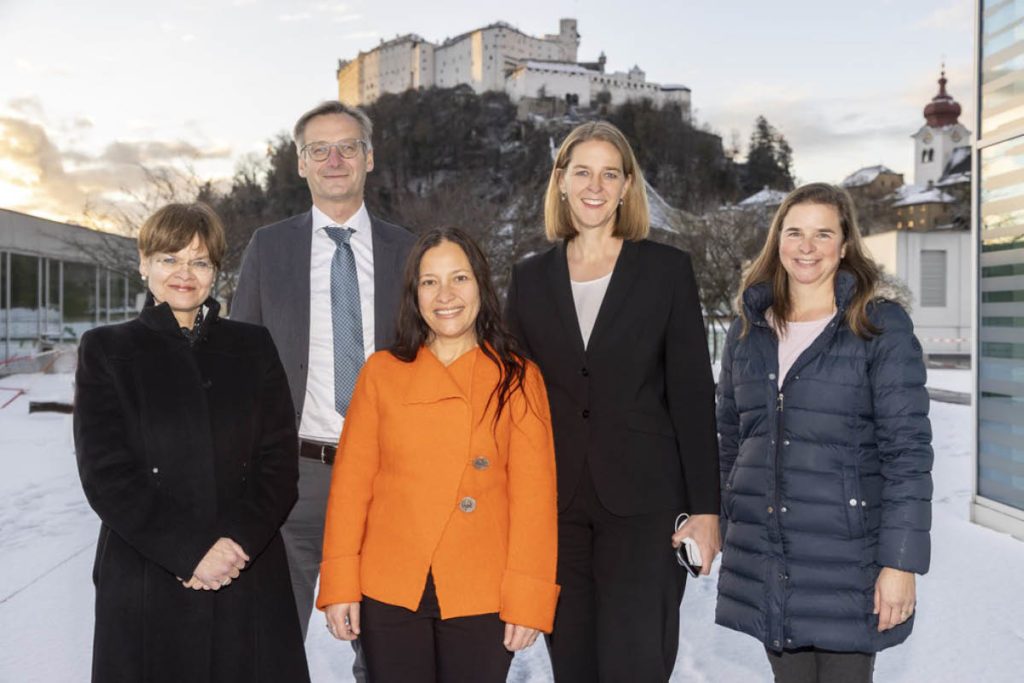
The Paris Lodron University of Salzburg (PLUS) and the Salzburg University of Education (PH) are launching the Innovation Lab for Education “INTER-DI-KO” starting in autumn 2022. The lab aims to test new educational formats by bringing together three key areas for the future of education:
- Interdisciplinary questions in the face of the societal crises of the 21st century
- Technological advancements in knowledge communication
- Collaboration between schools, universities, and higher education institutions
The lab will focus on building “Future Skills,” which are essential skills for the future, among students. The core areas of focus are the 4 Cs: Collaboration, Creativity, Communication, and Critical Thinking. Digital tools will be leveraged as drivers to explore new forms of communication. Ulrike Greiner, project leader at PLUS, emphasizes that all stakeholders involved in education will participate in testing new teaching formats within the Innovation Lab.
A key aspect of the implementation is how educators can effectively teach relevant topics such as climate change, democracy, social cohesion, new media cultures, gender, and artificial intelligence in schools. Months before the start of the Innovation Lab, many schools in Salzburg expressed interest in participating and collaborating in this initiative.
Spaces for Approaching Technology
A laboratory space equipped with digital technologies will be established at the University of Education Salzburg (PH). Additionally, a mobile laboratory will be set up for use in schools. These labs will be available to all participants to test instructional innovations. According to Vice-Rector Martin Weichbold (PLUS) and Rector Daniela Martinek (PH), this project strongly reinforces the forward-looking collaboration between the institutions.
In this context, the nationwide initiative EdTech Austria provides a large network of companies, educational experts, and decision-makers. EdTech Austria is located at Innovation Salzburg and works closely with the entire project team. “Digital teaching and learning applications, known as EdTech solutions, have become indispensable in schools since the beginning of the pandemic. The question of which instructional settings yield the best learning outcomes for students using digital tools is still open. With this new project, we can experiment with innovative EdTech solutions in Salzburg, deliver research results, and create added value for all participants. This is unique for Austria,” says Hannes Aichmayr, project manager at EdTech Austria.
Focus on Students and Teacher Education
The Innovation Lab will be launched with two projects. In the “Giving Students a Voice” project, students actively participate in shaping the classroom as media producers. They learn to present school-based and self-acquired knowledge through various media formats such as podcasts, short films, videos, blogs, etc. In the process, they acquire not only subject knowledge but also digital skills and media literacy, as reported by Christine Trültzsch-Wijnen, the project manager at PH. The second project, “Developing the Classroom of the Future,” focuses on teacher education students. They develop new digital teaching materials for socially relevant topics and collaborative work.
Funding Enables Innovation Lab
The new innovation labs are being funded by the Innovation Foundation for Education. Alongside the Salzburg Innovation Lab, four other innovation labs in Austria have been awarded funding through the grant program. Over 700,000 euros are being provided, with 50% funded by the Austrian Research Promotion Agency (FFG) and 50% by the University of Salzburg, the University of Education Salzburg, and the State of Salzburg.
“When planning the innovation lab, we were convinced that digitization enables new instructional formats. The COVID-19 crisis has made digital skills urgently necessary in the education sector. The experiences gained now need to be utilized, and the positive results should contribute to future development,” says State Councillor Andrea Klambauer.
About EdTech Austria
In November 2020, Innovation Salzburg, the State of Salzburg, the Austrian Federal Economic Chamber, and the Salzburg Chamber of Commerce launched EdTech Austria. This initiative gives a boost to the future topic of educational technologies (digital applications that support learning). EdTech Austria aims to establish Salzburg as an EdTech pilot region and implement nationwide measures to establish educational technologies. The initiative is located at Innovation Salzburg. Digital learning technologies can grow with EdTech, leading teaching and learning into the digital future.
That might also interest you
3. June 2026
Featuring the Future: Young Talents Showcase Their Ideas
What does the future look like? Perhaps exactly as it was presented at the MINT Challenge 2026. In line with our motto “Featuring the Future”, 317 students from nine MINT secondary schools across Salzburg developed their own research projects over the past few weeks. At the grand finale on June 2 at the BAUAkademie Salzburg, the best teams presented their ideas to an audience and an expert jury.
28. May 2026
Joint Research Leads to Patent Application
An important milestone for Salzburg as a research and innovation hub: Salzburg University of Applied Sciences and ABB’s Machine Automation Division (B&R) have jointly filed a patent application in the field of AI-based energy efficiency.
21. May 2026
The Future of Microchip Manufacturing Comes to Salzburg
With the opening of a new competence center for so-called panel-level packaging, Lam Research is sending a strong signal for Salzburg as a technology and research hub.
15. April 2026
From AI to energy: Four Salzburg companies recognised
In 2026, the Salzburg Innovation Award was presented for the first time, introducing a new distinction for particularly innovative companies in the region. The four awarded projects highlight the diversity of innovation in Salzburg – ranging from satellite data and artificial intelligence to recycling technologies and digital energy infrastructure.